Pages

Showing posts with label Visual Communication. Show all posts

Monday, April 20, 2020

Visual Communication - Final Project with group

Form study
Simplification
Stylization
Subject - Sphynx cat


 Form study of hairless Sphynx cat - Chee Hong


Simplification of hairless Sphynx cat - Kim Swee


Stylization of simplified cat - Jasmine


Composition of hairless cat - Jasmine


Hairless cat on 30x30 cm canvas by Jasmine


Monday, March 30, 2020

Visual Communication - Element of Design: Form

Form is combining shape and value tto create the illusion of a three-dimensional subject on a flat surface.

Form is an element of art that is three-dimensional and encloses volume, including height, width and depth. Form may also be free flow.

The Principle of Organisation.
 The artist’s task is to bring order out of chaos, and whether the imagery is objective or non-objective, and is selected from the media and medium. Artist then begins by organizing the elements of art, such as line, shape, value, texture and color, and apply the 7 principles of design.
This is the organising process, which can be variously termed composition or design.

Form and Visual Ordering.
A completed work of art has three components:
1. Subject.
2. Form.
3. Content.

The components change only in the degree of emphasis. When we see images, we take a part in visual forming in an orderly manner.

Artists are visual formers with a plan. With materials, they can arrange the elements of design accordingly.

Elements of Design:
Point
Line
Shape
Texture
Value
Colour
Form

The elements of art are employed according to the principles of organisation, which has two paths, harmony and variety.

Harmony involves repetiton, rhythm, closure, or visual links. It could be one, or a combination of two or three, or all of them.

Variety involves factors of difference, contrast or elaboration.

With harmony and variety combined, they create the principles of organisation, which are:
Balance
Proportion
Dominance
Movement
Economy
which, in turn, creates space in order to produce unity in the visual arts.

Thursday, March 19, 2020

Visual Communication - Line Art


Visual Communication - Element of Design: Texture

Texture is an experience we always have with us. Because whenever we touch something, we can feel its texture. Texture is unique among the other art elements. Texture is the surface quality, or feeling, of an object and its smoothness, roughness, softness, etc.

Texture has two types, tactile and visual. Tactile means, of or connected to the sense of touch, so a tractile texture is the actual feel of an object in 3D.
Visual texture is the illusion of the surface of the object's texture. And it can visualise what a tactile texture look like in 2D. Texture in photographs are examples of visual textire. No matter how rough the objects in the photographs look, the surface of the photograph is smooth and flat.

There are 4 types of textures:
-Actual texture
-Simulated texture
-Abstract texture
-Invented texture

Actual texture is the real thing. The surface of an object can be expreienced through the sense of touch. We often descibe objects that are smooth, rough, soft, hard, fuzzy, silky, etc.

Simulated texture means that the surface of an object looks real, but in fact, it isn't. That's why it's called simulated texture.

Abstract textures usually display some hint of the original texture, and has been modified to suit the artist's particular needs.

Invented texture is, well, invented. It can be made up by artists' imagination, and it is not simulated or taken from real-world textures. Invented textures created by artists can be seen in abstract or non-objective artworks.

There are 3 ways to create texture:
1. Folding paper
2. Rubbing
3. Stamping

There may be more than 3 ways to create textures; just be creative, use your imagination and think outside the box.

"Don't forget to keep on thinking."
-Blocko, Life Noggin
https://www.youtube.com/user/lifenoggin

Monday, March 2, 2020

Visual Communication - Element of Design: Shape

A shape is an enclosed space, in a bounded two-dimensional form that has lenghth and width.

There are 2 types of shapes, geometric shapes and organic shapes.

Geometric shape is a shape that have exact measurements and that are not frequently seen in nature.

Organic shapes have,
-free form
-is seen in nature
-is unpredictable

Form as volumes, positive and negative form.

Positive form.
When form is perceived as occupying space, it is called a positive form.

Negative form.
When form is perceived as blank space surrounded by occupying space, it is called negative form.

If there is positive and negative form, then there's also positive and negative shape as well.

Positive shape is the shape of the actual object. (such as a window frame)

Negative shape is the spaces in between objects. (such as the space within a window frame)

Monday, February 24, 2020

Visual Communication - Line Art

What defines a line?

A line connects two points and can go on forever. It is made by tools such as pencil, pen, paint, paintbrish, etc.

Lines can create shape, texture and variety in art depending on how it is used.

Lines can also create sense of depth depending on how thick or thin you make it.

There are two types of line,
Real/actual lines and implied lines.

Real/actual lines are are lines that are physically present, existing as solid connections between two or more points.

Implied lines refer to the path that the viewer's eyes take in as it follows shape, colour and form within an art piece or artwork.

Monday, February 17, 2020

Element of Design - Point

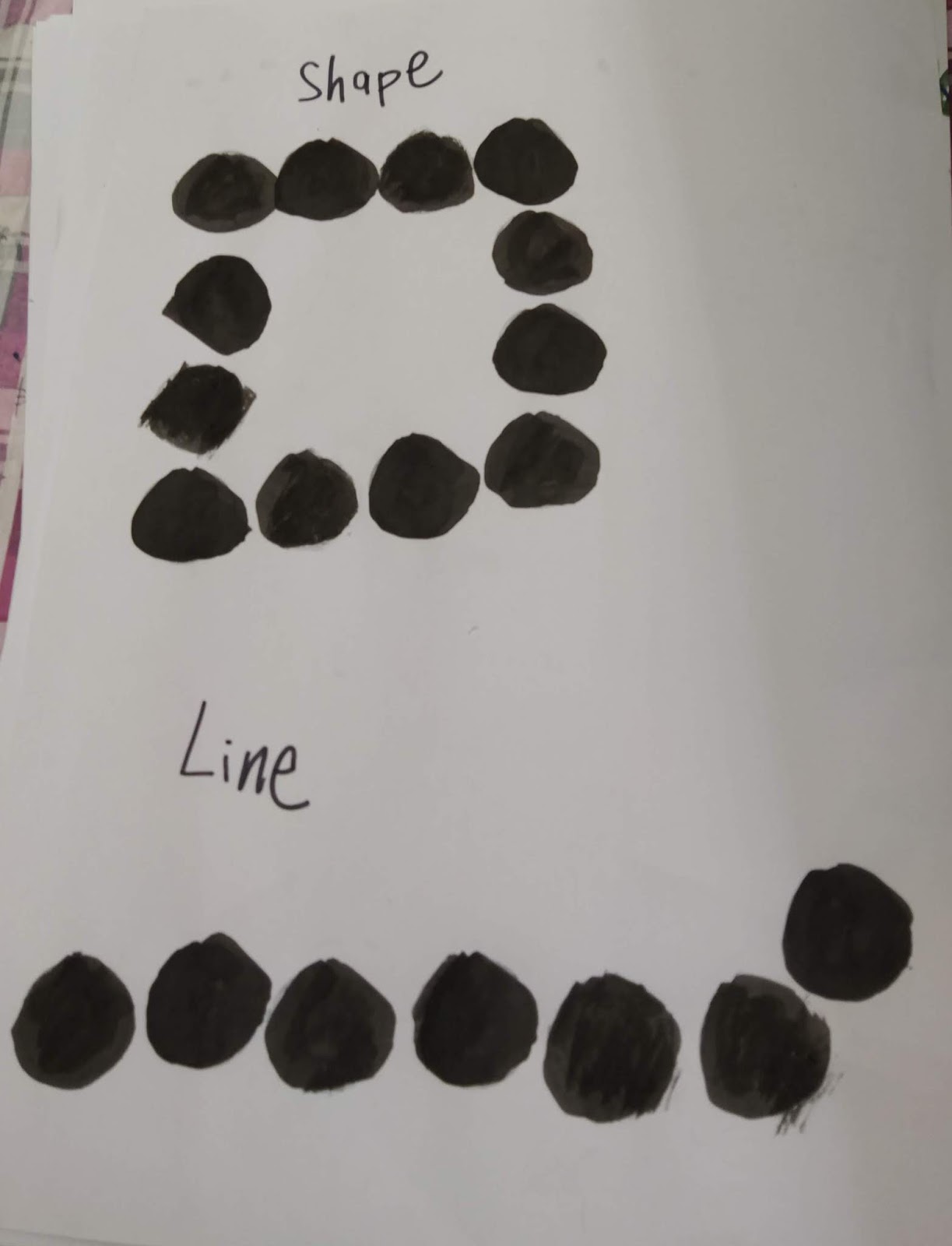
Without a point, or a dot, you can't draw any form of art. Without a point, the other elements of design/art cannot follow. Point is the first thing you must create in order to draw anything.

Monday, February 10, 2020

Visual Communication

Design Principles
Art Fundamentals
Basic Design

Art Fundamentals
----------------------
The experience of exploring art elements and media on a level of practical curiosity

3 things found in art
-------------------------
Subject - person, thing or idea
Form - art objects, elements and principles
Content - emotional or intellectual message or statement

Elements of Art
--------------------
Line
Shape and size
Space
Colour
Value
Texture

Principles of Art
---------------------
Balance
Contrast
Emphasis
Proportion
Gradation
Pattern

C-P-O
Concept
Professionalism
Originality